Digital Order Picking

Pick-by-Light vs. Pick-by-Voice vs. Pick-by-Scan vs. Pick-by-Tablet: Which method is right for you?

October 28, 2026

ekko Knowledge
Picking methods compared

Anyone looking to digitize their picking process first faces the question of method: light, voice, scanner, display, or smart glasses? Digital picking methods can significantly outperform paper-based processes in terms of speed and process reliability. However, there is no single "best" method. The deciding factor is which solution fits the specific process. This comparison shows how the five most important methods work, where their strengths and limitations lie, and which factors matter when selecting them for different picking zones.

What is paperless picking? Paperless picking replaces the printed pick list with digital guidance for the employee. The most common methods are Pick-by-Light (light signals on the shelf), Pick-by-Voice (voice dialogue via headset, also known as "acoustic picking"), Pick-by-Scan (handheld scanners/mobile terminals), Pick-by-Tablet or Pick-by-CMD (display on the picking cart), and Pick-by-Vision (smart glasses). They differ primarily in terms of speed, error rates, training time, and cost structure.

What picking methods are available?

The paper list – the classic starting point

Printing out a pick list, walking the aisles, checking items off: the barrier to entry is low, but it creates additional manual steps for searching, comparing, and documenting. This can be time-consuming and increase the risk of picking errors, which later lead to rework, returns, or complaints. Digital methods address these exact weaknesses, albeit in different ways.

Pick-by-Light: guided by light

Light indicators on the shelf bin show where and how much to pick; the pick is confirmed by pressing a button and reported in real time to the ERP or warehouse management system. Pick-by-Light is most effective in areas with high pick density in a compact space, such as picking zones, flow racks, or assembly and sequencing processes. Modern wireless systems can also be retrofitted to existing shelving without complex electrical installation. We have broken down just how significant these effects can be in our article on the benefits of Pick-by-Light.

Pick-by-Voice: guided by voice

The system announces the storage location and quantity via headset, and the employee confirms via voice command—hence the term "voice-directed picking." Pick-by-Voice is most effective where employees need both hands free or cover longer distances. This is suitable, for example, for large warehouses as well as refrigerated and frozen storage areas. With very high pick density in a confined space, however, sequential voice guidance can take more time than an immediately visible signal at the storage bin.

Pick-by-Scan: guided by scanner

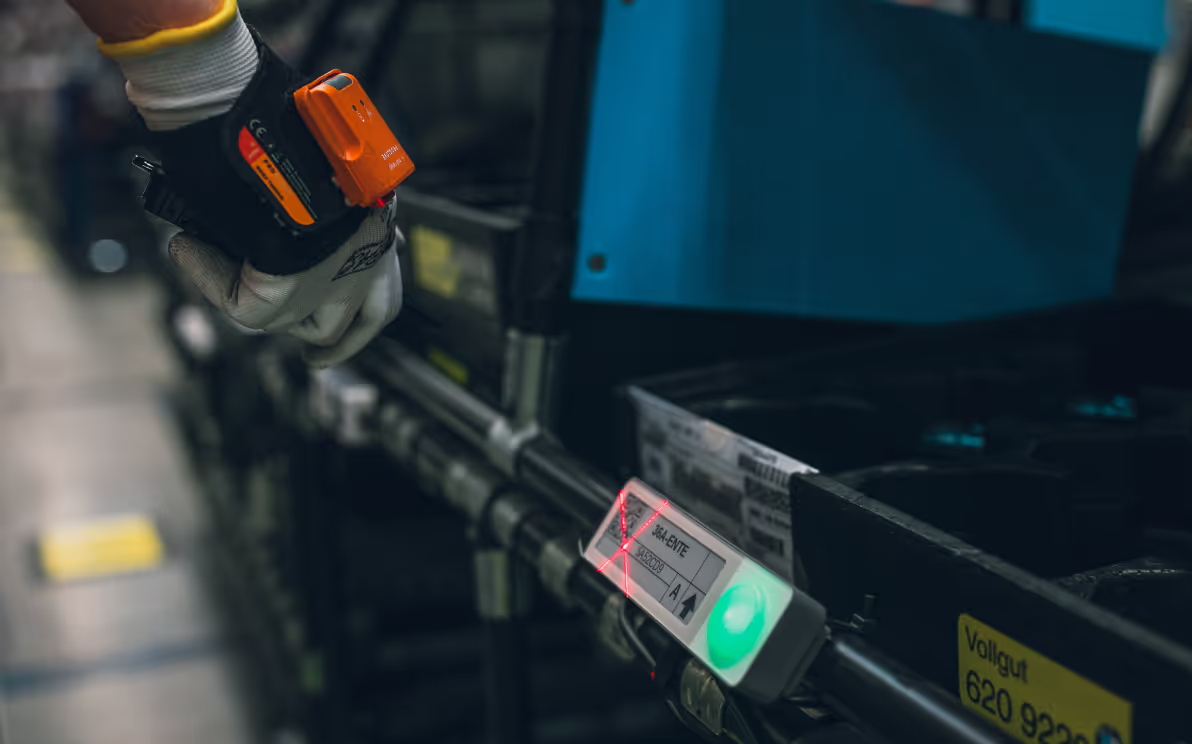
A handheld scanner or mobile data terminal indicates the location and verifies the pick via barcode scan. Equipment is provided per person rather than per storage bin, and scan verification is particularly suitable for processes where batches, serial numbers, or items must be clearly confirmed. However, the additional scanning process adds a step to every pick, and the device usually occupies one hand. At very high picking frequencies, this can be more time-consuming compared to light- or display-guided processes.

Pick-by-Tablet / Pick-by-CMD: guided by display

A tablet or a fixed display on the picking cart (cart-mounted display) shows the order list, quantities, and, if necessary, additional information such as product images or parts lists. This is the flexible middle ground: minimal hardware per bin, fast training, and well-suited for changing orders and small batches. In studies, display-guided methods perform similarly to light-guided ones in terms of speed. They simply shift the information from the shelf to the cart.

Pick-by-Vision: guided by smart glasses

Smart glasses project navigation and picking information directly into the user's field of view. In the test setup of the study described below, this form of guidance was among the faster digital methods. In practice, however, additional factors such as acquisition costs, wearing comfort, technical requirements, and acceptance over full shifts must be considered for Pick-by-Vision. This makes the method particularly suitable for applications where visual guidance in the field of view offers a concrete process advantage.

Pick-by-Light or Pick-by-Voice: What is the difference?

The short answer: Pick-by-Light indicates picks via illuminated displays directly on the shelf, while Pick-by-Voice uses voice-guided dialogue via a headset. The best method depends primarily on your specific process. In areas with high pick density in a compact space, the immediate visibility of light signals is a major advantage. Conversely, for long travel distances, the benefit of Voice is that it keeps hands and eyes free, and the next location can be announced while the picker is already on the move. Implementation also differs: light-guided processes are usually intuitive, whereas Voice requires staff to get used to voice commands and speech recognition. In practice, the answer is often not "either/or" but "both": the right method for each zone (more on that below).

Which picking method is the fastest?

There is no single fastest method. How quickly picking can be performed depends on factors such as travel paths, pick density, item structure, and process design.

A direct comparison is provided by a study from the Georgia Institute of Technology in collaboration with Ubimax. The study examined paper-based picking, light-guided picking, a cart-mounted display (CMD), and smart glasses (HUD). In the test, all three digital methods significantly reduced the time required compared to paper lists. Pick-by-Light saved about one-third of the time, while CMD and HUD achieved even shorter times in the experimental setup.

However, the results cannot be applied one-to-one to every warehouse: the test was conducted at a single workstation and does not account for factors like long travel distances or complex multi-user processes. Therefore, the chart is primarily useful for demonstrating the fundamental effect of digital guidance compared to paper-based processes, rather than for determining a universally fastest method.
Criterion
Pick-by-Light
Pick-by-Voice
Pick-by-Scan
Pick-by-Tablet / CMD
Pick-by-Vision
Particularly efficient for
high pick density, short distances
long travel distances, hands-free work
verification requirement
changing orders, additional information
visual guidance in the field of view
Process reliability
high through bin display and confirmation
high with reliable voice guidance
high through scan verification
high with clear digital guidance
high with clear visual guidance
Onboarding
usually short
Getting used to commands and voice recognition
usually short
usually short
Getting used to smart glasses and the display
Hands & eyes free
Hands largely free
Hands and eyes free
no (device in hand)
partial
Hands-free
Cost logic
Hardware per storage bin
Equipment per person
Equipment per cart/station
Equipment per person
Ideal for
high pick density, zones, sequence formation, assembly
long travel distances, cold/frozen storage
goods receipt, low frequency, batch/serial numbers
changing orders with additional info
Applications with visual guidance in the field of view

Which method fits which application?

Four practical rules of thumb can be derived from this comparison:
  • Many picks in a compact area (picking zone, flow rack, sequence formation in assembly): Pick-by-Light is particularly suitable for high pick frequencies, short distances, and recurring processes. Visual guidance directly at the storage bin reduces search time and enables rapid onboarding.
  • Long travel distances and hands-free work (expansive warehouses, cold storage, and freezer areas): Pick-by-Voice plays to its strengths here because hands and eyes remain free during the guidance process.
  • Verification required and lower pick frequency (goods receipt, batch and serial numbers): Pick-by-Scan – scan confirmation is a key component of process reliability here.
  • Changing orders with additional information (small batches, special orders, kitting): Pick-by-Tablet/CMD can provide images, parts lists, and further information directly at the cart or workstation.
The best picking method? Often, it's more than one. A warehouse rarely consists of a single process: fast-movers sit next to slow-movers, standardized picks next to special orders, and short paths next to expansive storage areas. Consequently, the optimal picking method isn't necessarily the same everywhere. Instead of applying one technology across all areas, it can make more sense to adapt the guidance to the specific process: Pick-by-Light where many picks must be completed quickly and accurately; display-guided picking where employees need additional information. On a hardware-agnostic platform like ekko, different processes can be mapped within the same system. Orders originate from the same ERP or WMS, and feedback is consolidated centrally, while each zone receives the guidance best suited to its process.

And the cost question? The cost logic differs fundamentally (per bin vs. per person). We have broken down the actual system costs and how the investment pays off in our Pick-by-Light Cost Guide, which includes a calculation example.

Frequently Asked Questions about comparing methods

What are the disadvantages of Pick-by-Voice?

Pick-by-Voice requires getting used to voice commands and speech recognition. Furthermore, in high-density picking areas, sequential voice guidance can take more time than an immediately visible signal at the storage bin. In noisy environments, it must also be ensured that speech recognition functions reliably under the specific conditions.

What is Pick-by-Tablet?

With Pick-by-Tablet (also known as Pick-by-CMD, or Cart-Mounted Display), a display mounted on the picking cart or workstation guides the order, including additional information such as images or parts lists. This method requires minimal hardware per bin.

What is voice-directed picking?

Another term for Pick-by-Voice: The system announces the storage location and quantity via voice output, and the employee confirms via voice command. This keeps hands and eyes free.

Can picking methods be combined?

Yes. Different warehouse zones often have different requirements. For instance, Pick-by-Light can be used in a high-density picking zone, while display-guided picking supports special orders with additional information. On a hardware-agnostic platform like ekko, multiple methods can be managed within the same system.

Which picking method is the most cost-effective?

That depends on your volume and processes. For example, scanner solutions require hardware per employee, whereas Pick-by-Light requires hardware per storage bin. Therefore, the most economical method cannot be determined by purchase price alone. Key factors include pick frequency, time savings, error costs, and ongoing operating expenses.

Unsure which method suits your zones? We will analyze your processes and recommend the right combination—even if the answer isn't Pick-by-Light for every area.
Want to know which picking method is best for your processes? We provide concrete, complimentary advice.
Send a request

Learn more about our out-of-the-box solutions

Download product overview

Technical options with ekko

Examples from our customers

Detailed ROI calculations

Download product overview

Privacy policiesImprint